In 2026, we're optimizing for quality, not revenue.
By optimizing for craft, staying focused and close to our users we believe we can build a sustainable business and a product we're proud of.
Last year, our strategy was simple. We had one clear goal: to reach 10,000 subscribers. We didn’t just hit it. We doubled our revenue and ended the year at 12,000 customers.
But when we started thinking about our goals for 2026, we asked ourselves a more fundamental question:
What kind of company is Tally, and what do we want it to become?
That might sound obvious, but it deserved some real thought. Our situation, and Tally itself, is very different from most startups.
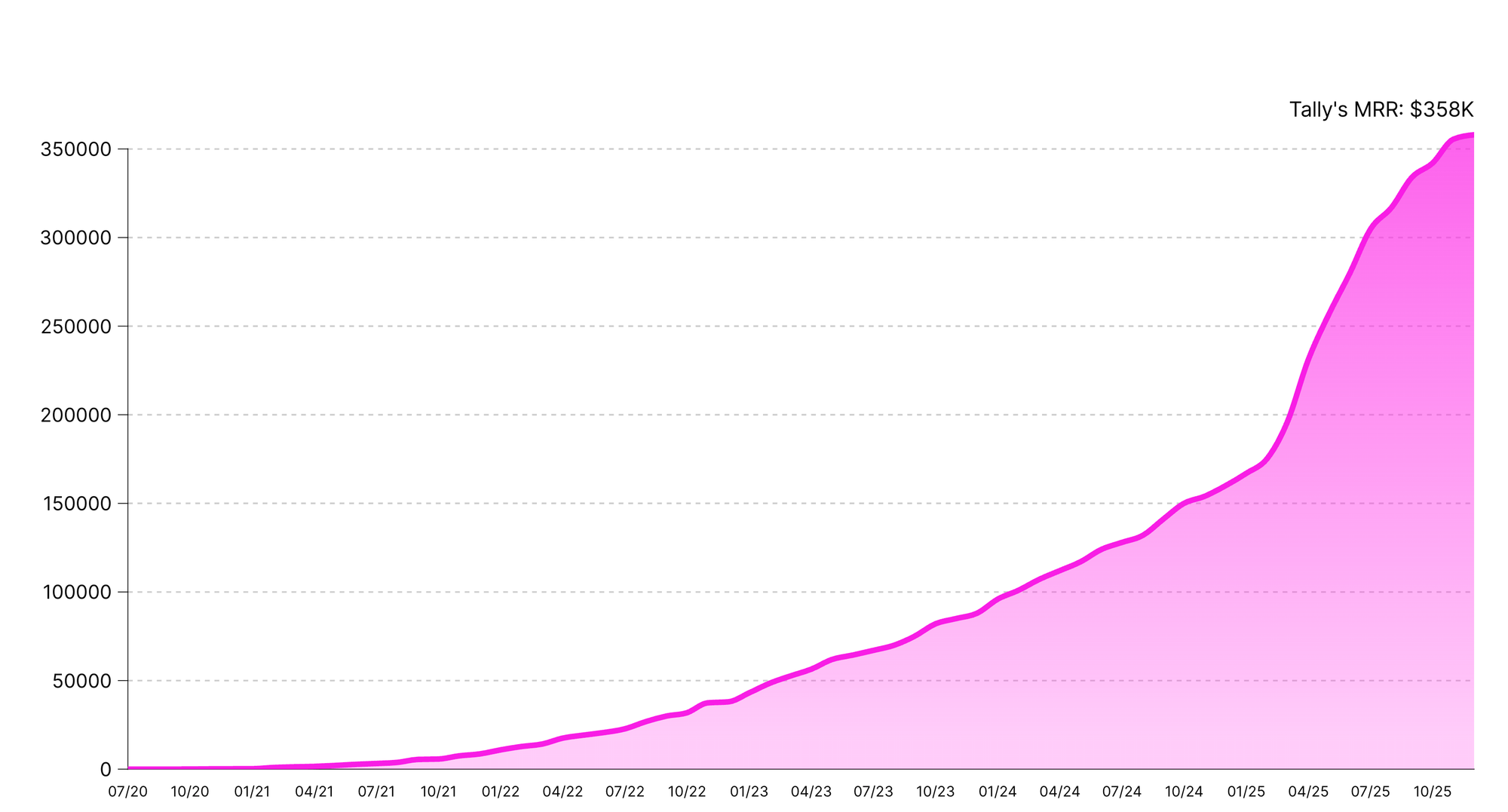
If you're new here, this is a recap of our journey:
| Sept. 2020 | $0K | How we ended up building a form builder |
| Mar. 2021 | $1K | From MVP to Product Hunt launch |
| Oct. 2021 | $5K | Bootstrapping to $5K MRR and 11K users |
| Dec. 2021 | $8K | Wrapping up 2021 |
| Feb. 2022 | $10K | Bootstrapping to $10K MRR and 20K users |
| Jun. 2022 | $20K | Growing from $10K to $20k MRR |
| Oct. 2022 | $30K | Bootstrapping our SaaS to $30K MRR |
| May 2023 | $60K | Bootstrapping our SaaS to $60K MRR |
| Sept. 2023 | $75K | Launching Tally 2.0 |
| Feb. 2024 | $100K | Bootstrapping to $100K MRR |
| Nov. 2024 | $150K | Bootstrapping to $150K MRR |
| Feb. 2025 | $175K | We crossed $2M ARR |
| June 2025 | $258K | From $2M to $3M ARR |
| October 2025 | $338K | From $3M to $4M ARR |
| January 2026 | $358K | Here we are 📍 |
When Filip and I started building Tally, we simply wanted to build a sustainable lifestyle business for our family, as indie hackers. Fast-forward a few years: over 1 million users, $4M ARR, a team of 10, and two kids later, life looks very different.
So we paused and asked ourselves: What do we actually want? And just as importantly, what don’t we want?
What makes Tally different
We’re an independent, bootstrapped company, with no external shareholders. That means no pressure to maximize revenue or shareholder value. Our only real obligation is to the people who fund us: our users.
We also have optionality, a concept Jason Fried from 37signals describes perfectly. Optionality comes from a mix of:
- healthy profit margins
- a small team
- independence
- building an opinionated product
- the freedom to make unconventional choices
If a board is calling the shots, margins are thin, the team is too big to change direction quickly, or you’re afraid to build something opinionated, you don’t have optionality.
But if you do, it unlocks things no one needs to give you permission for:
- Thinking long-term instead of chasing quarterly targets
- Ignoring conventional growth metrics
- Writing excellent software and giving a lot of it away for free
This isn’t a constraint. It’s our superpower. And it’s exactly what we’re doubling down on.
And, lastly, we’re in it for the long run. Tally turns five this year. We want to build a business that grows calmly and sustainably, something we still enjoy working on years from now, at a pace that’s healthy for ourselves.
Our mission stays the same
We believe the only way to build this kind of company is by obsessing over quality and trusting that the rest will follow. So for 2026, our mission doesn’t change:
We want Tally to be the simplest form builder out there.
Not the biggest. Not the fastest-growing. But the simplest, and the most thoughtful, to use. And we’re not there yet.
Optimizing for quality means:
Building what users actually need. We listen obsessively through support emails, conversations, feedback, and community signals. Every interaction teaches us something.
Removing friction and delivering value fast. We eliminate unnecessary complexity. We improve onboarding and templates, and help users reach their “aha” moment as quickly as possible.
Sweating the details. Quality has to show up everywhere. We kill projects that don’t meet our standards. Every interaction, from product to brand to content, should feel intentional and delightful.
Focusing relentlessly. The hardest part isn’t deciding what to build. It’s deciding what not to build. That means consciously saying no to ideas, opportunities, and even things that might help us grow.
So no enterprise plans, sales calls, demos, partnerships, big events, or big launches. I’m sure some of these would move numbers. But everything comes with tradeoffs.
We’ve kept the team small while growing to over a million users, and we intend to keep it that way. We’re a team of 10 and we’ll grow the team slowly and deliberately. We want to spend our time building, not managing politics.
Taking small, incremental steps. We choose continuous improvement over hype. We’ll ship, listen, and improve every week. Big launches create pressure, slow us down, and optimize for peaks and stats we don’t need.
How we’ll measure success
Here’s the unconventional part: we won’t have a revenue goal in 2026.
Instead, we’ll track signals of product quality:
- NPS score (quarterly)
- Feedback through a new in-product feedback button
- User reviews
These help us answer what really matters:
- Are people happy?
- Do they feel heard?
- Is the product easy to use?
What this means for how we work
Focusing on quality isn’t something that sits with one team or one role. Product quality becomes a collective responsibility. Everyone stays close to the product, and everyone is encouraged to have an opinion. Feedback comes from all corners: support conversations, bug reports, user replies, community signals, and the small moments where something feels slightly off when you use the product yourself.
We want short feedback loops. When users point out paper cuts or missing details, we act on them quickly. Fixing small annoyances, smoothing rough edges, and addressing bugs isn’t “maintenance work”. It is the work. Shipping features users ask for, and doing so thoughtfully, matters more than chasing shiny new features.
Keeping the team small makes this possible. It forces clarity and focus, and it keeps us close to the people we’re building for. The tradeoff is that we can’t do everything, but the upside is that we can do the important things well.
Looking forward
We can’t outspend, out-market, or out-ship VC-backed competitors. But we can obsess over quality. Delivering an exceptional experience isn’t a race. It takes time, patience, care, and product taste.
We don’t optimize for revenue numbers. We optimize for craft. We’re not chasing viral moments or big launches. We’re staying calm, focused, and close to our users.
We’re betting that by doing excellent work, we can build:
- A sustainable business
- A product we’re genuinely proud of
- A company that lasts
We’re optimizing for the work itself, and for the long game. And by doing this, the numbers will follow.
Here’s to another year of building a product we love.
— Marie